


To link to this article from your blog or webpage, copy and paste the url below into your blog or homepage.
The Aging Population
an article by our site
Those 14 to 25 in 1990 (the baby bust) represented a much smaller group than the baby boomers before them (who were 26 to 44 in 1990). In 1990 there were 44 million people between 25 and 34. By 2000 there was only 37 million, a 16 percent decrease. (Source: Russell, Cheryl, "Trouble Ahead," American Demographics, March 1990, p. 2.)

Elders are 12.4% of the population in 2000 but will be 19% of the population by 2030
Boomers have recently hit the 65+ category. As an example, the older population--persons 65 years or older--numbered 39.6 million in 2009. They represented 12.9% of the U.S. population, about one in every eight Americans. By 2030, there will be about 72.1 million older persons, more than twice their number in 2000. People 65+ represented 12.4% of the population in the year 2000 but are expected to grow to be 19% of the population by 2030.
The number of 25- to 44-year-olds grew by 30 percent between 1980 and 1990 and shrunk by 3.4 percent between 2000 and 2010. The population aged 65 or older grew 23 percent from 1980 to 1990 (Source: "Snapshots of the Nation"), more than twice as fast as the population as a whole, and grew by 15.1 percent between 2000 and 2010.

Elder care will be part of more people's lives as the 21st century progresses
However, between 1990 and 2020 the number of those 50 and older will increase by 74 percent, while the number under 50 will increase by only 1 percent. In 1990 one in four Americans is 50 or older. By 2020 one in three will belong to this group. It's difficult to predict exactly how much the increase will be because changes in the mortality rate can have a big effect on the numbers. In the 1970s the mortality rate fell substantially, while it fell more slowly in the 1980s.
See The Age Wave: How The Most Important Trend Of Our Time Can Change Your Future.
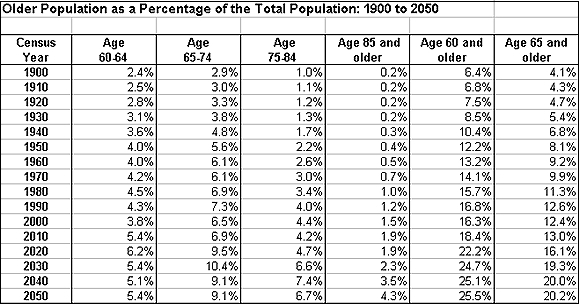
(Source: US Bureau of the Census)