


To link to this article from your blog or webpage, copy and paste the url below into your blog or homepage.
Ritalin Gone Wrong
an article in The New York Times by L. Alan Sroufe
(our site's article review)
Sroufe, in a well-researched and well-thought-out article that manifests courage, compassion, and wisdom, tells us that "To date, no study has found any long-term benefit of attention-deficit medication on academic performance, peer relationships or behavior problems . . . One of the most profound findings in behavioral neuroscience in recent years has been the clear evidence that the developing brain is shaped by experience. . . What we found was that the environment of the child predicted development of A.D.D. problems. In stark contrast, measures of neurological anomalies at birth, I.Q. and infant temperament—including infant activity level—did not predict A.D.D. (attention-deficit disorder)."

Children's basic emotional and social skills are dropping in over 40 indicators—they're more nervous, irritable, sulky, moody, depressed, lonely, impulsive and disobedient; blaming this on defective brains is a copout—it's the environment of the child that predicted development of A.D.D. problems, not brain chemistry
Sadly, says Sroufe, few doctors and few parents seem to be aware of these new research results about the lack of effectiveness of these drugs. The drugs—like Ritalin—can also have serious side effects, including stunting growth. And who knows what the long-term effects will be on these young people?

More pills for kids means more cash for Big Pharma
The New York Times is to be commended for its courage in printing this article, since it surely won't be putting any smiles on the faces of Big Pharma people. Did it lose The New York Times any advertising money? Who is to say? We hope not—unless the ads are for drugs to stuff down kids' innocent little throats!
It used to be believed that kids with attention problems require attention-deficit drugs to correct their problem. Many psychologists and psychiatrists and teachers STILL believe this, even though it has been shown to be based on reductionistic thinking. But this rush-to-medicate stance not only is making a fortune for Big Pharma, but doesn't it seem just a bit too convenient the way it seems to get politicians, scientists, teachers and parents off the hook? "The kids' brains and biochemistry are messed up," is how the self-serving logic goes.
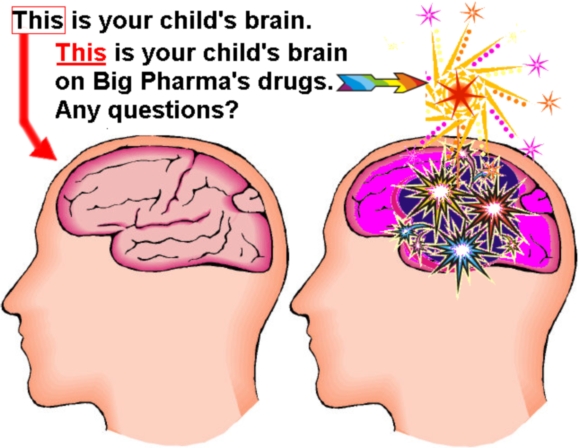
Our kids' brains and biochemistry are messed up, so drug 'em senseless!
Dr. Sroufe and his associates have been studying children who were born into poverty and were therefore more vulnerable to behavior problems. Dr. Sroufe and his associates studied not just the kids, which would have been reductionistic, but also their surroundings from before birth through childhood and adolescence for decades, at the University of Minnesota. Studying both children and their environment is a holistic approach bound to get better results than just studying kids' brains—which is a behavioristic approach similar to how behaviorists study rats in laboratories. Surely our kids deserve better than to be treated like rats!

Surely our kids deserve better than to be treated like rats!
"If drugs, which studies show work for four to eight weeks, are not the answer, what is? Many of these children have anxiety or depression; others are showing family stresses. We need to treat them as individuals," says Dr. Sroufe. What is so sad is that intelligent, well-educated adults need to be reminded of this obvious fact!

The rush-to-medicate stance is making a fortune for Big Pharma and it conveniently gets parents off the hook for messing up their kids!

Big Pharma spreading "good health via medicine" across the land