


To link to this article from your blog or webpage, copy and paste the url below into your blog or homepage.
Unsettled: What Climate Science Tells Us, What It Doesn’t, and Why It Matters
a book by Steven E. Koonin
(our site's book review)
The Amazon blurb says that “Surging sea levels are inundating the coasts.”

Surging sea levels are inundating the coasts occasionally—as is normal

Grab the life rafts—here comes a flood—again
“Hurricanes and tornadoes are becoming fiercer and more frequent.”
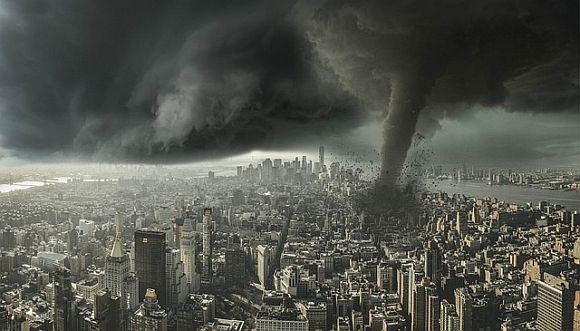
Hurricanes and tornadoes are becoming fiercer and more frequent? Not really.
“Climate change will be an economic disaster.”
You’ve heard all this presented as fact. But according to science, all of these statements are profoundly misleading.
I knew I should have brought an umbrella—and a lightning rod
When it comes to climate change, the media, politicians, and other prominent voices have declared that “the science is settled.” In reality, the long game of telephone from research to reports to the popular media is corrupted by misunderstanding and misinformation. Core questions—about the way the climate is responding to our influence, and what the impacts will be—remain largely unanswered. The climate is changing, but the why and how aren’t as clear as you’ve probably been led to believe.

The long game of telephone from research to reports to the popular media is corrupted by misunderstanding and misinformation—the science is a long way from 'settled'!
Now, one of America’s most distinguished scientists is clearing away the fog to explain what science really says (and doesn’t say) about our changing climate. In Unsettled: What Climate Science Tells Us, What It Doesn't, and Why It Matters, Steven Koonin draws upon his decades of experience—including as a top science advisor to the Obama administration—to provide up-to-date insights and expert perspective free from political agendas.

Steven Koonin, one of America’s most distinguished scientists, is clearing away the fog to explain what science really says (and doesn’t say) about our changing climate
Fascinating, clear-headed, and full of surprises, this book gives readers the tools to both understand the climate issue and be savvier consumers of science media in general. Koonin takes readers behind the headlines to the more nuanced science itself, showing us where it comes from and guiding us through the implications of the evidence. He dispels popular myths and unveils little-known truths: despite a dramatic rise in greenhouse gas emissions, global temperatures actually decreased from 1940 to 1970. What’s more, the models we use to predict the future aren’t able to accurately describe the climate of the past, suggesting they are deeply flawed.

Koonin dispels popular myths and unveils little-known truths: despite a dramatic rise in greenhouse gas emissions, global temperatures actually decreased from 1940 to 1970, when gas-guzzling cars were all the rage; are we on the verge of climate hell? No!
Koonin also tackles society’s response to a changing climate, using data-driven analysis to explain why many proposed “solutions” would be ineffective, and discussing how alternatives like adaptation and, if necessary, geoengineering will ensure humanity continues to prosper. Unsettled: What Climate Science Tells Us, What It Doesn't, and Why It Matters is a reality check buoyed by hope, offering the truth about climate science that you aren’t getting elsewhere—what we know, what we don’t, and what it all means for our future.
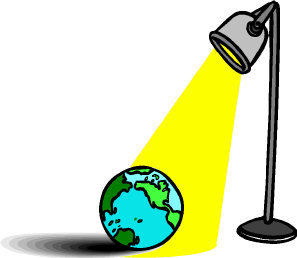
Humans exert a growing, but physically small, warming influence on the climate
As Koonin sees it, "Humans exert a growing, but physically small, warming influence
on the climate. The deficiencies of climate data challenge our
ability to untangle the response to human influences from poorly
understood natural changes.
"The results from the multitude of climate models disagree with,
or even contradict, each other and many kinds of observations. A
vague “expert judgment” was sometimes applied to adjust model
results and obfuscate shortcomings.

The results from the multitude of climate models disagree with, or even contradict, each other and many kinds of observations. A vague 'expert judgment' was sometimes applied to adjust model results and obfuscate shortcomings
"Government and UN press releases and summaries do not accurately reflect the reports themselves. There was a consensus at the meeting on some important issues, but not at all the strong consensus the media promulgates. Distinguished climate experts are embarrassed by some media portrayals of the science.

Distinguished climate experts are embarrassed by some media portrayals of the climate science emergency
"In short, the science is insufficient to make useful projection:
about how the climate will change over the coming decades, much
less what effect our actions will have on it.
"Why were these crucial deficiencies such a revelation to me and others? As a scientist, I felt the scientific community was letting the public down by not telling the whole truth plainly. And as a citizen, I was concerned that the public and political debates were being misinformed. So I began to speak out, most publicly through a two-thousand-word “Saturday Essay” published in the Wall Street Journal that September. In it, I outlined
some of the uncertainties in climate science and argued that ignoring them could hinder our ability to understand and respond to a changing climate.

The 'existential climate emergency' the liberals scare people with to get them to toe the liberal party line sometimes produces skepticism and doubt in people who like to do their own thinking, which gets leftist radicals furious
"Climate alarmism has come to dominate US politics, especially among Democrats."
“The most important book on climate science in decades.”— Rupert Darwall, RealClearPolitics
“The book is no polemic. It’s a plea for understanding how scientists extract clarity from complexity. And, as Mr. Koonin makes clear, few areas of science are as complex and multidisciplinary as the planet’s climate.”— Mark P. Mills, Wall Street Journal
“Any reader would benefit from its deft, lucid tour of climate science, the best I’ve seen.”
— Holman W. Jenkins, Wall Street Journal
“Fascinating and informative reading, and one hopes it will improve the climate for honest and open discussion.”— Jonathan Tennenbaum, Asia Times
“Koonin points out scientific facts supported by hard data and the peer-reviewed literature.”— Tilak Doshi, Forbes

We have too many global warming books--but this one is needed. Steven Koonin has the credentials, expertise, and experience to ask the right questions and to give realistic answers
“We have too many global warming books—but this one is needed. Steven Koonin has the credentials, expertise, and experience to ask the right questions and to give realistic answers.”— Vaclav Smil, distinguished professor emeritus at the University of Manitoba
“Unsettled: What Climate Science Tells Us, What It Doesn't, and Why It Matters is an excellent case study on climate science, its inherent complexity and uncertainty, and a cautionary tale on how interpretive filters in the policymaking process have shaped, and sometimes misinformed, the climate policy debate. It should on be the reading list of scientists and engineers whose responsibility, as citizens, extends beyond the laboratory to communicating to a larger public often overwhelmed and confused by the media. Policymakers and politicians will find it a source of reflection for their arguments, positions, and decisions.”— Jean-Lou Chameau, President Emeritus, Caltech
“Essential reading and a timely breath of fresh air for climate policy. The science of climate is neither settled nor sufficient to dictate policy. Rather than an existential crisis, we face a wicked problem that requires a pragmatic balancing of costs and benefits.”
— William W. Hogan, professor of global energy policy at Harvard Kennedy School
“Tough talk about climate politics from a statesman scientist—and a vision of what will actually come to pass.”— Robert B. Laughlin, professor of physics at Stanford University

Koonin documents how much of what you think you know about climate just ain’t so—you needn't build a fallout shelter and crawl into it to await your untimely demise
“Steve Koonin, the undersecretary for science under Obama, has written a very interesting and thoughtful book on climate. He documents how much of what you think you know about climate just ain’t so. Did you know that while the United States is now seeing many fewer cold records, absolute heat records are not increasing? Unsettled: What Climate Science Tells Us, What It Doesn't, and Why It Matters will definitely and rightly unsettle your climate thoughts, and all for the better. If we are to make trillion dollar investments, we deserve to be as well informed as possible.”— Bjørn Lomborg, president of Copenhagen Consensus and visiting fellow at The Hoover Institution at Stanford University

Did you know that while the United States is now seeing many fewer cold records, absolute heat records are not increasing?
“Over the past thirty years, the incidence of natural disasters has dramatically increased,” Treasury secretary Janet Yellen falsely asserted last month in a pitch supporting the Biden administration’s infrastructure package. All over ths administration, people are lying to push a radical socialist agenda. Turning science into the whore of politicians is shameful, but the mainstream media flunkies were unashamed and unrepentant. They've reached the supersaturation point in their corruption where there are no more morals—there is only hollow virtue signalling. Much like the leftist politicians, who seems to believe that virtue signalling is actual virtue. Whenever they want extra credit in their virtue signalling, they hop aboard the Trump hate train and point out "flaws" in Trump (which turn out to be lies—like the collusion witchhunt, or good traits liberals call bad, like his great deeds in the Mideast or his border policies which turned out to be correct).

Whenever leftists want extra credit in their virtue signalling, they point out flaws in Trump (which turn out to be lies, or good traits liberals call bad, like his great deeds in the Mideast or his border policies which turned out to be correct)
“Being effective” helps explain the pressure on climate scientists to conform to The Science and the emergence of a climate science knowledge monopoly. Its function is, as Crawford puts it, the manufacture of a product – political legitimacy – which, in turn, requires that competing views be delegitimized and driven out of public discourse through enforcement of a “moratorium on the asking of questions.” This sees climate scientist gatekeepers deciding who can and cannot opine on climate science. “Please, save us from retired physicists who think they’re smarter and wiser than everyone in climate science,” tweeted Gavin Schmidt, NASA acting senior climate advisor, about Koonin and his book. “I agree with pretty much everything you wrote,” a chair of a university earth sciences department tells Koonin, “but I don’t dare say that in public.” Once again, fear of being canceled forces people to toe the party line.

Once again, fear of being canceled forces people to toe the party line
Scientist gatekeepers requires that competing views be delegitimized and driven out of public discourse through enforcement of a “moratorium on the asking of questions.” This sees climate scientist gatekeepers deciding who can and cannot opine on climate science—a malignant arrangement at best.
Dr. Steven E. Koonin is a leader in science policy in the United States. He served as Undersecretary for Science in the US Department of Energy under President Obama, where he was the lead author of the Department’s Strategic Plan and the inaugural Quadrennial Technology Review (2011). With more than 200 peer-reviewed papers in the fields of physics and astrophysics, scientific computation, energy technology and policy, and climate science, Dr. Koonin was a professor of theoretical physics at Caltech, also serving as Caltech’s Vice President and Provost for almost a decade. He is currently a University Professor at New York University, with appointments in the Stern School of Business, the Tandon School of Engineering, and the Department of Physics. Dr. Koonin’s memberships include US National Academy of Sciences, the American Academy of Arts and Sciences, and the JASON group of scientists who solve technical problems for the US government. Since 2014, he has been a trustee of the Institute for Defense Analyses and chaired the National Academies’ Divisional Committee for Engineering and Physical Sciences from 2014-2019. He is currently an independent governor of the Lawrence Livermore National Laboratory and has served in similar roles for the Los Alamos, Sandia, Brookhaven, and Argonne National Laboratories.
See also:
- The Deliberate Corruption of Climate Science
- The Madhouse Effect: How Climate Change Denial Is Threatening Our Planet, Destroying Our Politics, and Driving Us Crazy
- Losing Earth: A Recent History
- "A Disgrace to the Profession"
- The Politically Incorrect Guide to Climate Change (The Politically Incorrect Guides)
- This Changes Everything: Capitalism vs. The Climate
- On Fire: The (Burning) Case for a Green New Deal
- Climate Change Reality Check: Basic Facts that Quickly Prove the Climate Change Crusade is Wrong and Dangerous
- The End of Ice: Bearing Witness and Finding Meaning in the Path of Climate Disruption
- The Uninhabitable Earth: Life After Warming
- Wicked & Wise: How to solve the world's toughest problems
- The Polar Bear Catastrophe That Never Happened
- Falter: Has the Human Game Begun to Play Itself Out?
- The Ends of the World: Volcanic Apocalypses, Lethal Oceans, and Our Quest to Understand Earth's Past Mass Extinctions
- Scienceblind: Why Our Intuitive Theories About the World Are So Often Wrong
- Only Love Remains: Dancing at the Edge of Extinction
- Not a Scientist: How Politicians Mistake, Misrepresent, and Utterly Mangle Science
- Gently Fixing Global Warming: ... how we got here to where we must go
- Political Mind Games: How the 1% Manipulate Our Understanding of What's Happening, What's Right, and What's Possible

'What could possibly cause all this melting ice? My money's on all those long, hot stinkers you've been letting! Pee-yew! I mean, what else could it be?'