


To link to this article from your blog or webpage, copy and paste the url below into your blog or homepage.
SELLING THE MC CONCEPT
an article by our site
The Seven Satisfiers
As a business management consideration, the marketing of the MC concept needs to use as a guideline The Seven Satisfiers of Success, as outlined in the book The Decision Makers, by Robert Heller.
An analysis of the MC concept in reference to its marketability in Seven Satisfiers terms follows immediately after:
(a) a statement of concept that attempts to pinpoint general MC definitions and goals
(b) an examination of needed world-view changes
(c) an example of dealing with a specific social malady in MC terms
The MC movement is a matrix for maximizing the quantity and quality of fulfilling or nurturing relationships for optimal cultural enhancement. More simply, MCs maximize social resources for the purpose of cultural transformation. Resource configurations are optimized so that the social experiences (all relationships) of all individuals are successful and the culture therefore has an effective basis from which to operate, since if relationships are weak, the culture must eventually weaken as well—which has been happening in the U.S. for decades.
The world view which will be both cause and effect in MC movement germination is that of the new, ecological‑holistic paradigm, as opposed to the old, mechanistic paradigm, which perceives the world in win-lose, exploitative, reductionistic, Cartesian, growth‑obsessed, paternalistic terms. (René Descartes' philosophy was reductionistic—Cartesian refers to his ideas.)
The best statements of these contrasting paradigms can be found in Fritjof Capra's book The Turning Point and the best social-cultural manifestation of the ecological‑holistic paradigm with its win-win, holistic, cooperative, ecologically-wise, Third Wave systems view is the MC movement. MCs have maximized social resources, maximized relationship wisdom, maximized caregiving and parenting wisdom, and maximized communication efficiency resulting in maximized nurturing, maximized lifestyles, and yet minimized economic expenditures regarding both caregiving costs (free) and gas for transportation. The minimized economic expenditures will be particularly appreciated as childcare costs rise and yet childcare center quality does not. Less gas use will be particularly appreciated as gas price costs rise. In addition to all the savings from trips not made to either daycare centers or to friends’ houses (most are in the MC itself, so they are a few steps away), the savings in time that would have been spent in driving kids to and from caregiving sites or friends’ houses, as well as the savings in time that would have been spent in adults driving to friends’ houses needs to be considered as well.

From the 1970s to the 1990s good/excellent quality care went from 26% to 13% in centers; MCs' caregiving costs (free) and gas for transportation (minimal) represent minimized economic expenditures which will be particularly appreciated as childcare costs rise and yet childcare center quality decreases
In essence, the MC lifestyle is the best, most effective, most efficient, most inspiring lifestyle ever devised, and it results in optimal parenting, optimal psychological health for all concerned, optimal life satisfaction and happiness, and optimal cultural evolution of the best possible kind.
In the past, such a description would be written off as unrealistic hyperbole. Such hyperbole would be used to describe cults, communes, ashrams, or religions that lived up to none of the hype. Or it would describe gated communities, time-shares, co-housing developments, pedestrian pockets, or intentional communities of various types. But a community is only as strong as its weakest link and the people, the parenting, the nurturing, the relationships, and the lifestyle itself would all compete for being said weak link in the above lifestyle modes.
The MC, on the other hand, actually is what the above description specifies. Read all MC Articles on this website as well as the novel The Forest Through The Trees if you doubt this. An MC is an intentional community of a new type that exists in suburban blocks, apartment buildings, condos, motels, hotels, RV parks, etc., but people live in normal configurations in normal nuclear (or other types) families and there is no altered density patterns at all. Families live normally, physically. It is the relationships that change, including adults, children, parenting, relatives, and friendship relationships.
It also reinvigorates community functioning (see The Responsive Communitarian Platform), which the Communitarian platform of the Communitarian Network says requires a major social movement, and they also say that “our first and foremost purpose is to affirm the moral commitments of parents, young persons, neighbors and citizens, to affirm the importance of the communities within which such commitments take shape and are transmitted from one generation to the next.” The primary context of the Communitarian platform is the prioritization of family, community, children, morals, values, and cooperation, using less reliance on government, laws, courts, police, shrinks, social workers, and social engineering to solve our problems, most of which can be dealt with at the local level of family and community. Currently the de facto priority in the U.S. is to things, money, escapism, conspicuous consumption, and competition. This has corrupted values, morals, character, families, communities, corporations, politics, and the overall health of our nation both economically and psychologically, and it has crippled future generations before they arrive.
The Tofflers point out that in the Third Wave information age, high-quality power (knowledge) based on information and wisdom and the application of same needs to be used to revamp community, lifestyles, parenting, families, government, corporations, international and economic relationships, politics, and power itself.
The profound need for solidarity with one's fellow humans, for experiencing some sense of power in one's worldly endeavors, and for a sense of meaningful identity and relatedness to one's environment leads the young people in many disadvantaged inner‑city neighborhoods to try to overcome the disconnectedness, disaffectedness and alienation they feel by forming close‑knit peer groups which often express frustration by violence, substance abuse, trafficking in illegal substances (or arms), and a general attitude of rebellion and antisocial lawlessness. Gangs are a survival strategy. People who join them do so because they have not been given any reasonable alternative that might fill the various unmet needs for security, solidarity, nurturance and identity.

Ironically, the psychological and social drives which lead adolescents to form gangs are in themselves healthy
Since the psychological and social drives which lead them to form such groups are in themselves healthy, the most useful way to view all potential solutions to the problems that gangs create is not in terms of support for police actions and wars on drugs, but in terms of potential to fill social needs. In other words, can we provide a healthier alternative to gangs that allows the young to become happy, healthy, productive citizens—an alternative that can evolve as a result of these healthy drives? If we can and do provide such an alternative, and gangs still form, they will be much more likely to be positive associations like the Guardian Angels, Boy or Girl Scouts, Boy's Clubs or youth corps.
Once the MC movement is happening, U.S. citizens CAN and WILL create these alternatives in the form of revamping social configurations in these disadvantaged neighborhoods in the MC direction. One of the ways that young and old from nondisadvantaged neighborhoods can help to make life in their cities safe, happy and meaningful for all is to help people in disadvantaged neighborhoods to make their situations workable, nurturing and productive.
People in MCs in disadvantaged areas are likely to either clean up their neighborhoods as they clean up their acts or move out en masse and do their MC thing elsewhere. In some cases, grants or loans from cities or benefactors will be necessary to facilitate the civic action of cleaning up an area, but the costs will obviously be trivial compared to the costs of dealing with the symptoms of severe disaffectedness which are guaranteed to continue to manifest if we take no action. Prisons, drug wars, gang activities (such as vandalism, gang wars, drive-by shootings and theft), lost productivity and extra law enforcement personnel all have high economic, social and psychological costs for all those involved. Note that only people showing a desire for MCs are included in the agenda here, and no outside force or agency or bureaucracy is involved. Only MC people are involved, people who will guide themselves out of their plight, and if they ask for guidance from MCs in nondisadvantaged neighborhoods, those wanting to guide will do so. This is just healthy community involvement, not social engineering. No one has power over anyone and no one is telling anyone else what to do, feel, believe, or think.
Note that the civic action of cleaning up an area is not social engineering but community involvement. No grants or loans from cities would be part of MC formation or maintenance. If benefactors wished to help with location costs involved in MC creation, that's their privilege and their right. But the MC formation process needs to strenuously avoid bureaucratic influence, involvement, or interference. We all know what happens when bureaucrats get involved: graft, corruption, exploitation, oppression, bad guidance, immorality, influence peddling—the list is endless. They would quickly try to make themselves "essential" elements of MC formation, and then require city taxes to pay their salaries, and their influence would soon start contaminating the MCs, their values, their motives, etc., as these bureaucrats became parasitical to the process and their bureaucracy was expanded to "meet the needs of the people," which, translated into the language of truth, means "meet the needs of the bureaucrats for money and cancer-like growth." Do you doubt this? Think of how politicians, lobbyists, and lawyers operate in Washington D.C. Are they public servants or simply parasites who lie to the public as they act in the best interests of the Corporatocracy and themselves? Once you clearly see who they're really serving, ask yourself who they'd serve if they began trying to influence the MC movement. Get the picture? And that, folks, is why it is essential to keep bureaucrats away from MC movement actions. To repeat, the MC formation process needs to strenuously avoid bureaucratic influence, involvement, or interference!
With this context established, nondisadvantaged helping disadvantaged is encouraged, but only after the nondisadvantaged have stable, successful MCs going and their heads and hearts are in the right place. The trouble with the advantaged looking down on the disadvantaged, in general, and (unconsciously) gloating "we win; you lose," is that the people forced to be losers by environmental circumstances eventually find a way to make the advantaged lose as well, even if not intentionally. (The percentage of the population of the U.S. in prison increased by over 250 percent from 1950 to 1990. Whose taxes pay for all this?) And the trouble with bleeding-heart liberal do-gooders trying to make themselves feel better about themselves by doing something good for the disadvantaged people or neighborhoods is not in the actions themselves, but in the one-upmanship context and the source of the good actions, which is trying to feel better about themselves by getting involved with less fortunate people which validates them as “winners” when dealing with “losers,” in addition to dealing with alienation and unhappiness by trying to feel better by seeing others worse off. The one source that is a truly healthy one is compassion and wanting to feel good about oneself by doing something nice for others.
But if nondisadvantaged MCs help disadvantaged MCs succeed as part of a sense of community responsibility, out of humanity, and out of a desire for the type of social evolution that will turn life around for this country and this world, it is not only compassion at work but ecology in its best sense, and a great example of being guided by the wisdom of the ecological‑holistic paradigm.
The biospherical context applies here with special emphasis: we are all one. To allow part of an entity to sicken and disintegrate but then to somehow feel that this has no effect on the other parts of the entity is to practice blind isolationism and reductionism, i.e., the mechanistic paradigm. Systems thought is required.

The biospherical context applies here with special emphasis: we are all one
Innovators, in order to be successful, have to find defects in present products or ideas and present a product or idea that is without such defects. In all seven of the satisfiers below, whenever a need of any kind is mentioned it will be assumed that you have already read the Novel and you therefore know how the MC movement will address that need.
Satisfier 1. Unfilled Needs
- UNITY. Social, political and international unity is in short supply; the symptoms of this shortage are overwhelming and often frustrate and depress thinking humans. Enhanced connectedness, relatedness and oneness internationally as well as in the community, neighborhood and family are needed. We are all one.
- ECOLOGICAL APPROACHES TO ECONOMICS. To succeed in the next century, businesses and governments will have to have global, not national or company economic perspectives. Ecology will have to be factored into the bottom line of economic formulas, along with health, safety, and environmental factors. Economists will have to state their underlying value frameworks and quit pretending to be "value‑free" and therefore "scientific." Systems economics, as opposed to reductionistic Keynesian economics, will be the new paradigm's contribution to economic perspective. And the supremely unecological blind faith in the economic axiom in which one almost unconditionally maximizes one variable (profit, output, etc.) will have to be replaced by faith in the ecological‑holistic axioms of systems economics. See The Politics of the Solar Age: Alternatives to Economics, a book by Hazel Henderson.
- EFFECTIVE COMMUNICATION AND RELATIONSHIPS. Intentionally seeking compatible people via appropriate MC database search techniques, and intentionally creating neighborhoods (MCs) containing these people for friendship and childcare purposes is vastly superior to the random chance methods people usually use now—as if relationships and friendships were of little significance. MCs will need PSBs (personal status boards) for enhanced personal expression, to avoid invasive communications, and for optimal social and psychological coordination, connectedness, and effectiveness. Close encounters of the first (MC), second (community and nation) and third (world) kinds will be examples to emulate from older to younger MCs and MC members.
- FLAT-GRADIENT NURTURANCE. There is a crying need for more choices for children regarding who their caregivers are. Children will pick the caregivers that are most nurturing of their beings, if given half a chance. But current abuse and neglect statistics, in homes, home-care and daycare caregiving, show that adults often set up situations that are far from nurturing for their children. Multiple caregiving (once basic security is achieved at around six months of age, after having experienced mostly one primary caregiver's care) is the key to having nurturing strategies work well for both today's kids and today's (usually working) mothers. The kids need the other choices and the freedom to follow their lifewish instincts regarding caregivers, while the parents need the freedom not to center every thought around children. The results will be more self‑actualization, better character development, the development of more respect and responsibility, and more compassionate and cooperative kids that operate from a win‑win perspective more often and can therefore be expected to harmoniously accompany the world-view transformation from the old, win‑lose mechanistic paradigm to the new, win‑win ecological paradigm.
- MEANING. There is a conspicuous lack of meaningfulness in such areas as media (TV, movies, books, etc.), relationships, life goals, lifestyles, and world views. MC close encounters of the first (MC), second (community and nation) and third (world) kinds, the paradigm shift, and the MC movement itself will address these concerns directly.
Satisfier 2. Disadvantages in Established Products, Institutions Or Traditions
- NEIGHBORHOODS ARE RANDOMLY FORMED, nonintentional—a crap‑shoot. Therefore social resources are rarely optimized, compatibility is sparse, and harmony, trust, solidarity and depth of relationships is very limited. In this mobile society, close‑knit subcommunities are rare and optimized social networks and nurturance matrixes are virtually nonexistent.
- THE ISOLATED NUCLEAR FAMILY IS NOT FUNCTIONING WELL. Most families are dysfunctional, have inadequate human resources, are isolated and alienated and attempt to substitute vicarious TV viewing for both family and community relationships, and have combinations of authoritarian and permissive parenting strategies that are seriously ineffective and unwittingly teach irresponsibility, disrespect and resentment. They're disconnected from the many humans in their community that could—and would like to—be part of their nurturance and friendship networks. The young have no positive examples to emulate so they idolize MTV stars whose morals, messages and world views are questionable at best. The various win‑lose character traits imprinted upon the young as a result of artificially intensified oedipal emotions and sibling rivalries, and the common practice of mother‑child identity overwhelm, tend to limit children's abilities to cooperate, form nurturing, unneurotic relationships and become secure, calm, happy beings. Steep‑gradient nurturance nearly guarantees that few such benevolent character traits evolve. And cycles of people abuse and/or substance abuse (often they go hand in hand) are not often broken, because of the secrecy of the problems and the co‑dependency syndromes that develop. Family dysfunction feeds upon itself and gets worse because families are usually isolated from adequate human resources to facilitate healing. And to break the isolation and actively seek additional resources is heavily stigmatized. See Family Dysfunction.
- LACK OF EFFECTIVE SOCIAL AND PERSONAL COMMUNICATION. Many of the communication habits of individuals in our families and communities are intrusive in that they tend to disturb others' sleep, peace, or studies. PSBs are seen as a godsend here, since telephones, although vital and effective tools, are often part of the action when one person inadvertently disturbs another. True, today’s social networks as well as texting and chatting and emailing have created more friendship opportunities and less intrusive forms of communication. But this doesn’t mean that communication between people has become more effective, but just more frequent, sometimes to the point of obsession. And although the communication has become less intrusive technologically, it is more intrusive in its effect. The medium is the message. And the message is that communication has become so hyper-available that we tend to do more of the low-quality stuff because it is so easy but less of the high-quality stuff because it isn't. Facebook is 90% people wasting an ungodly amount of time on superficial stuff, which gives them little time to learn the art of high-quality communication. (For example, relatively few people know or practice the essential high-quality communication P.E.T. skills of active listening, conflict resolution, use of I-statements, no-lose problem solving, communication from a win-win context, avoiding communication roadblocks, etc. But everyone knows how to spread gossip, blab about videos and movies, insult, bully, and name-call.) Communication networks are often far too narrow to effectively serve all one's friendship or nurturance needs, and this is because relationship networks themselves are similarly narrow and inadequate. One might have 11,247 Facebook friends, but be alienated, lonely, isolated, and depressed. Quantity is not quality. People tend to communicate best and most with IRL friends, whether on Facebook or F2F. The best online communication happens between people who are friends IRL as well. TV vicariousness is so much "safer" than taking the risk of real relationship, which is why the average home has its TV on seven hours a day. Lack of control of personal space by "alone" signs, locks and agreements often undermines the security, acceptance, effectiveness, and timing of family communications. Note: Facebook has some cause for concern. For example, by 2013, 28% of users say the social network has become less important to them than it was a year ago, and 34% say the amount of time they are spending on Facebook has decreased over the past year. And in a new research report, entitled Coming and going on Facebook, Pew Research Center shines a light on a sense of dissatisfaction some Facebookers feel towards the network that has caused them to cut back the amount of time spend on the site or abandon it altogether. Perhaps they're finding lower quality relationships and targeted ads boring. (Took them long enough!)
- CHOICELESS NURTURING, BABY-SITTING OR DAYCARE.
- INADEQUATE CAREGIVING. Much of the care in daycare centers, neighborhood home care, home care with baby-sitter, and home care by parents or sibling is simply inadequate, non-need‑filling, ambivalent, and of random consistency and quality. Sometimes it's even abusive, neglectful or humiliating. And caregiving and the scheduling that goes with it is often experienced as an incredible burden, strategically, logistically, economically and emotionally. Adults are often obliged to try to force themselves to act nurturing and attentive when they are not, because there are no alternate nurturers available. This is experienced as very frustrating and unhappy by child and adult alike.
- ATTEMPTS OF GOVERNMENT, POLITICIANS, LAW ENFORCEMENT PROFESSIONALS, PSYCHOLOGISTS, AND SOCIAL WORKERS TO ADDRESS THE SYMPTOMS OF FAMILY BREAKDOWN AND DYSFUNCTION ARE USUALLY SUPERFICIAL, INEFFECTIVE OR BOTH. The problem, of course, is that prevention would be so much more effective than cure. But that would mean a clear understanding of, and an effective strategy to deal with, root causes.
- THE EXPERT INTERVENTION STRATEGY as the major mode of addressing social dysfunction is invasive, degrading and ineffectual since the interventions are too little and too late. Waiting for symptoms to appear and then applying heroic social engineering is a basically socialistic idea that is incredibly inferior to preventative measures taken at the individual level with regards to lifestyle adequacy.
- MEDIA, TV, MOVIES AND BOOKS are mostly devoid of thought-provoking, challenging or inspiring content. Sci-Fi ebooks are mostly dystopian, about violence and hate and oppression and terrorism and armageddon and ugly fanatical power groups attempting to dominate by authoritarian force. Adventure ebooks are mostly dystopian, about violence and hate and oppression and terrorism and armageddon and ugly fanatical power groups attempting to dominate by authoritarian force. But there are hordes of heroic-soldier ebooks of combat, war, and terrorism. Seeing a pattern here? Violence in movies and books and video games seems to be all that the public can relate to. MC-themed ebooks will be about nurturing, love, relationship and family and community enhancements, communication, compassion, inspiration, insight, self-actualization and autonomy. See the difference?
- LIFESTYLE AND PARENTING HELP IS NOT CONVENIENTLY WITHIN REACH OF THE AVERAGE ADULT. This website and the best Authoritative and Democratic Parenting Programs around were created to address this lack. A plethora of symptoms in the character, families and relationships of the majority of the citizens in our society demonstrates the need for such aid. Winning Family Lifeskills books, seminars and workshops, as well as P.E.T. books, videos and courses are additional amelioratives. And MC-based TV shows, magazines, and other ongoing media will continually provide assistance.

What remained when most social tasks were exteriorized in the 1950s was the isolated ‘nuclear family,’ held together less by the functions its members performed as a unit than by fragile psychological bonds that are all too easily snapped

Pew shines a light on many Facebook users' unhappiness with the network; some use it less and others quit it entirely; maybe they're bored with lower quality relationships

The bureaucrats have been foot-dragging because to admit that we now know what to do is to talk themselves out of a job, so they say we need to 'study' it more (so the 'experts' will stay employed!) The bottom line is that kids are getting a raw deal because the social support networks kids and families need are weak or absent. We get it! They know it and we know it and we DO know what to do about it. Check this website! There is no money for socialistic programs run by Big Government heroes, nor would they work. So the people will have to quit looking for political heroes to save them and START BEING TOTALLY RESPONSIBLE FOR THEIR OWN LIVES, CHILDREN, AND FAMILIES. IF THEY DO SO ACCORDING TO THE WISDOM IN OUR NOVEL The Forest Through The Trees, THEY'LL NO LONGER NEED 'EXPERTS' BECAUSE THEY, THEMSELVES, WILL BECOME THEIR OWN EXPERTS!

Adventure ebooks are mostly dystopian—about violence, and there are lots of heroic-soldier ebooks of combat, war, and terrorism. See a pattern here? Violence in movies and books and video games seems to be all that the public can relate to
Satisfier 3. Gaps In Otherwise Well‑Served Markets
- LACK OF HIGH‑QUALITY MOVIES AND TV PROGRAMMING. Movies like Awakenings, Dead Poets Society, Pay it Forward, Grand Canyon and Dances With Wolves are few and far between. Even the best movies and programs rarely offer high‑quality solutions to the profound questions they ask and the serious social problems they cite. At least they are good at posing the questions.
- CHILDCARE. Truly convenient, nurturing, economical, effective, secure, choice‑providing and growth‑promoting childcare is rare.
- INTENTIONAL COMMUNITIES. Most communities are random, directionless and without real goals. Most intentional communities have no real intentions beyond comfort and bodily security and are for retirees or singles or wealthy people vying for the safety of walled enclaves, like aristocracy heading for their castles. Normal communities could have well‑defined goals and strategies of accomplishing them, and subcommunities (in the form of MCs) inside these communities could pursue these goals intentionally, peopled by MC members who have intentionally come together to form intentional neighborhoods.
- PSB. The telephone-communication and social networking and texting and chatting and emailing markets are well-served. But there will be a growing need for a new kind of communication soon. Once MCs are under way, the need for noninvasive communication that’s also efficient and holistic will increase, and this unifying and coordinating device will find use not only in MCs but in businesses as well.
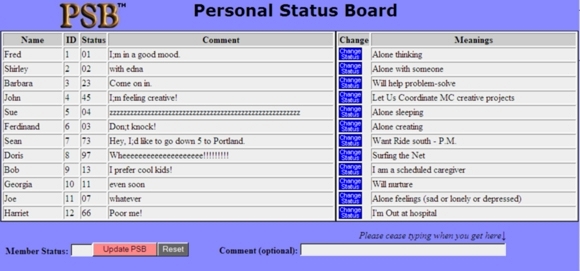
A PSB
Satisfier 4. Extensions Or New Formats For Proven Lines
- MC. Improves neighborhood and community format, and family and relationship viability.
- MC CHILDCARE. Improves on current format in almost all possible ways.
- MC VALUES. A synthesis of the best of the good, old, traditional values (respect, responsibility, the value of work, and the values of love, compassion, sensitivity, understanding, doing to others what you would have them do to you, freedom and democracy) with the best of the new-paradigm values and P.E.T. rules (win‑win, cooperation, active listening, problem solving, creative solutions, alone space, respect for space and choice, the character building that comes from "adventuring," ecology, holistic perspectives, environmentalism, systems perspectives).
- P.E.T. IMPROVEMENTS. Parent Effectiveness methods and other authoritative methods (Authoritative and Democratic Parenting Programs) offer a new parenting format and relationship strategy that can actually work more effectively within the context of MCs, since there are more human resources available to make these methods viable; there are PSBs to prompt clear, noninvasive self‑expression, communication and active listening; there are alone signs and alone space rules to enhance respect and sensitivity; and there is a full‑time life commitment to make relationships work well and, simultaneously, fewer people in MC people's lives who serve as bad examples and who thereby dilute the values, intentions and integrity of the individuals involved.

Each person in each MC is to have his/her own personal space
Satisfier 5. Technological Advances
(All of those listed exist only because of the advances in integrated circuits, computer technology, computer programming and silicon chip technology.)
- PSB
- NATIONAL MC DATABASE
- CAREGIVING SCHEDULING SOFTWARE
- FUTURE: MULTIMEDIA MC CAMPAIGN
- CHILD MONITORING AND TRACKING DEVICES
Satisfier 6. Transferable Successes In Other Markets
- BIDIRECTIONAL SOCIAL ENHANCEMENT TRANSFER. Middle class MC successes are predicted to spread into lower and upper classes simultaneously.
- INTERNATIONAL SOCIAL ENHANCEMENT TRANSFER. The rest of the world will want MC successes once the United States has demonstrated the MC's panacea potential.
- PSB AS BUSINESS STATUS BOARD COMMUNICATIONS DEVICE.
- PSB AS A PORTABLE SOCIAL OR BUSINESS ENHANCEMENT DEVICE. Mobile phones and Smartphones can combine to make PSB technology available to people on the move. All people on the road or at work or at the beach need to do to get their MC’s statuses is log in to their PSB online or use the PSB app on their device.
- PSB AS NON‑MC‑RELATED RETIREMENT COMMUNITY OR SINGLES COMMUNITY COMMUNICATIONS DEVICE.
- FLAT-GRADIENT NURTURING, A TRIED AND TRUE PROVEN METHOD FOR THOUSANDS OF YEARS IN DOZENS OF CULTURES, AS A SOCIAL ENHANCEMENT TRANSFER FROM "UNDERDEVELOPED" TO "DEVELOPED" COUNTRIES.
- SWEDISH CHILDCARE SUCCESSES PROMPT OTHER COUNTRIES TO USE THE BEST PARTS OF THESE STRATEGIES AS EXAMPLES TO EMULATE.
- COMPUTER-DATING SUCCESSES PROMPT OTHER TYPES OF ORGANIZATIONS TO ADOPT THIS HIGH‑TECH METHODOLOGY (E.G., MC MATCHING USING MC DATABASES).
Satisfier 7. More Economical Ways Of Satisfying Needs Now Being Expensively Met
- CHEAPER CHILDCARE. MC people will mostly trade care rather than paying for it. And there will be no time-, energy- and money-consuming commuting to get kids to childcare sites. Nor will there be eventual counseling and therapy costs and psychiatric drugs associated with ineffective childcare or involvement of teens in gangs because of the defects in their family and community environments.
- COTTAGE INDUSTRY ECOLOGY, EFFICIENCY AND EFFECTIVENESS. The enhanced human environment and childcare potentials of cottage industry work‑at‑home configurations (as in Tofflers’ electronic expanded family found in his The Third Wave), along with the improvements with regards to pollution, energy conservation, health care, and time, will make this one of the most popular advances in the work environment since Middle Ages guilds.
- SOCIAL NEEDS FILLED USUALLY WITHOUT THE NEED OF AUTOMOBILES. With family (and sometimes relatives), best friends and childcare right in the neighborhood, many environmental problems will be decreased, such as pollution, freeway jamming, gridlock, time‑wasting, and inordinate stress production and psychosomatic illnesses. Communities can be people‑centered rather than car‑centered (e.g., Davis, California). Family budgets will stretch further as energy efficiency increases and energy usage decreases. Use of nonrenewable resources will slow.
- VAST REDUCTION IN THE SOCIAL, PSYCHOLOGICAL AND ECONOMIC COSTS OF FAMILY DYSFUNCTION. The amelioratives used for stress reduction and symptom suppression take a big bite out of family budgets. And, contrary to the naive formulations of the mainstream economists, these things are NOT forms of productivity and should NOT be included as part of the national GNP our country is so proud of. Ecological systems perspectives on such goods and services have them SUBTRACTING from the bottom line, not adding to it. In truth, not only system‑suppressing chemicals but also such social costs as litigation, accidents and excessive health care limit and preclude productivity; they do not add to it.

Tofflers' electronic expanded family found in his The Third Wave
Such things as tranquilizers, alcohol, tobacco and sedatives (and that's not mentioning illegal drugs, which don't even get reported in economic summaries) are more often used to cover up family‑dysfunction‑caused problems than for any other reason. And these are problems which can be virtually eliminated by MC methods, thereby precluding the stresses, family dysfunction and unfilled needs that prompt people to reach for a "chemical solution" in the first place. Of course, the chemical side of family (and community) dysfunction treatments is only part of the picture—it has to be added to the bills for counseling, therapy, divorce, prisons, crime, vandalism, illegitimacy and illiteracy that all directly or indirectly result from family disintegration and community ineffectiveness. MCs are the alternative to all this, and will save incredible amounts of money, time, relationships and well‑being.
national debt
Unless American citizens start defecating money, the debt has put us all in deep doo-doo

With MC adoption, defense industry personnel can change their jobs to ones in which they help repair the cracking infrastructure of the country
- REDUCING THE NATIONAL BUDGET . As the world adopts MC methods, the defense budget can go down as people in the defense industry change their jobs to ones in which they help repair the cracking infrastructure of the country, revamp mass transit, and use high‑tech knowledge and production facilities to build solar energy cells, wind turbines, and power satellites (yes, weapons plants CAN retool and create win‑win, life technology rather than win‑lose, death technology). Drug-war money can go into toxic waste clean‑up. Nuclear weapons money (some, not all, as we need to keep a balance of power, at least in the foreseeable future) can go into education so our schools cease being third‑rate. The welfare system will cease to condition (some, not all) welfare mothers to continue to be irresponsible, unemployed, poor and unmarried, as it lets MCs create indelible contexts of responsibility in their members, who then turn around and become part of the solution, rather than part of the problem. Welfare will begin to be what it should have been from the start: necessary help for those who can't, rather than unnecessary help and irresponsibility conditioning for those who won't even try.
- REDUCING POLLUTION CLEAN‑UP COSTS. The responsibility context instilled in MC members will preclude any of them from acting in environmentally irresponsible ways.
- INCREASED PRODUCTIVITY IN ALL WORKERS. As MCs spread, productivity will skyrocket because of the evolving responsibility context and the increased efficiency of cottage-industry organizations. We'll be able to duplicate the most effective parts of the Japanese manufacturing strategy—which is mostly based upon dependent subcontractors—but without the hierarchical, feudalistic, domination of the small by the large so prevalent in Japan. The American version of the type of industrial or service-industry organization that will give us the best aspects of the Japanese system without requiring the negative aspects, is Toffler's flex-firm or fam-firm. The latter refers to the family while the former refers to flexibility. See Toffler's Powershift.

As MCs spread, productivity will skyrocket because of the evolving responsibility context and the increased efficiency of cottage-industry organizations
MC adoption doesn't require going against any time-honored tradition or habit, or any monolithic ad campaign. In fact, it re-adopts some respected and admired traditions from times past that had been left behind out of simple thoughtlessness and carelessness, and it enhances several modern, accepted traditions and habits.
|
|
One could assign a context of "going against the current tradition" to the MC characteristic of replacing authoritarian parenting with P.E.T. parenting, to be sure. But most current parenting strategies are a random conglomeration of habits blindly passed on from generation to generation, without any actual belief in their effectiveness—since every day they're employed in family settings they conspicuously fail and precipitate symptoms. Like bloodletting, in the history of medicine, today's parenting habits and pseudo-beliefs are begging to be replaced with viable, proven, effective methods that deserve the dignity of being believed in. Therefore it can be predicted that if a large enough, multipronged marketing approach (with real-life examples to emulate) were applied to this area—one which truly contained such a proven, successful parenting methodology—people would willingly let their hopeless methods and baseless ideas be replaced by the new methods and ideas.
Whether social marketing works or not depends upon a given society's readiness for the product, service, method, strategy or plan involved. What will work in one country won't necessarily work in another country at the same time. But the global consumption of Western media means that Western influence is such that countries not ready today may be ready tomorrow.
Is our culture ready for MC-focused social marketing? The major thrust of the MC is to create connectedness, community, good nurturing, and less social symptoms and alienation, and to allow the majority to take pride in their immediate environment (home, yard, neighborhood and community) and get involved in making life work for themselves, their neighbors, their friends, their community, their nation, and eventually the world. Now let's see how this compares to what Brad Edmondson, the Editor-in-Chief of American Demographics, had to say (December, 1991) about what the people of our country are yearning for:
"There is a big gap between the world we have and the world we want. We still agree that group action is the best way to solve certain social problems, but we do not agree on the best ways to take action. We are continuing to lose faith in our political parties . . . This gap between the world Americans have and the world they want gives businesses a potent opportunity. If your company can successfully position itself as a leader in community issues, you will have found one of the few ways to give a product mass appeal to the most desirable consumer groups. . . . What the uninvolved majority are really yearning for is what the involved few have—the sense of belonging to a community [italics ours]. People want to take pride in their surroundings and get involved, but they are stuck in the don'ts. They don't know how. They don't have time. They don't trust their leaders. This widespread yearning for community is showing up in popular culture. It is why nostalgic movies and television programs about small towns have become a national epidemic. . . . They are . . . watching comedies about extended families and wacky-but-endearing small towns. . . . In the 1990s, Americans may stop buying synthetic expressions of community and start rediscovering the real thing. [italics ours]. . . Positioning yourself as a friend of the community will be one of the only remaining ways to give your products and services mass appeal. . . . In the 1990s, the overriding concern of your best customers will be nurturing children and grandchildren. . . . The essence of target marketing is discovering a consumer need and filling it before anyone else does. And in the 1990s, people will have a need to celebrate community."

the majority of people are concerned about eliminating the gap between what they have and what they want, but they don't want this answer to come from mistrusted leaders
In other words, the majority of people are waiting for something that they can do about eliminating the gap between what they have and what they want. They don't want this answer to come from mistrusted leaders. They want it to be a real, concrete plan and not just more clichés and rhetoric. No more thousand points of light baloney. They want the actualizing of this plan to result in better-nurtured children, a feeling of belonging and community, and a sense that they can drop their hopeless, helpless, frustrating, noninvolvement stance and begin making a difference.
It is each person's responsibility to judge for himself or herself whether or not the MC movement dovetails with what our country's people are yearning for.
The Seven Satisfiers are not the only market analysis tool. Faith Popcorn's Discontinuity Trend Analysis is another such tool. Popcorn is responsible for the term Cocooning as well as the successful prediction of many trends. She is America's most highly regarded trend forecaster at present. Her book The Popcorn Report is a must-read for anyone making any future plans. If the plans are as big and bold as the MC movement, then that's all the more reason to include her book on the market analysis agenda. Putting the MC concepts through her trend analysis is vital to substantiating viability. Does the MC idea dovetail with current trends? Let's examine them. We'll see how closely MC ideas fit with each of the major trends which she has identified as critical in her book.
CASHING OUT: Working women and men, questioning personal/career satisfaction and goals, opt for simpler living. MCs will eliminate the need for most of the frustrating and time-consuming necessity of chauffeuring kids to and from daycare and friend's houses, as well as cutting down on all automobile needs. It will simplify all socializing. It will empower the cottage-industry trend as nothing else ever has. But in addition to the obvious simplification of normal, rat-race lifestyles, it will contribute to personal goal satisfaction as nothing ever has before. Having a lifestyle that nurtures, provides plenty of friends and close-knit neighborhoods and community connectedness, and, with its close encounters of the first, second and third kinds, gives life new meaning and undreamed-of potential—all this will be experienced as nothing less than a godsend. Making the world work will be seen as the mother of all goals. MCs are on-trend.
COCOONING: The need to protect oneself from the harsh, unpredictable realities of the outside world makes people stay home for security. Same analysis as above. Additionally, MCs will increase safety as kids are cared for at home or in the hub, and the dangers of unknown people in daycare centers are eliminated. "Neighborhood watch" realities will be automatic and intrinsic to all MCs. Even much of the danger of chauffeuring kids or driving oneself to friends' homes is eliminated as more socializing is now MC-centered. The obvious security enhancement from MC practices will be considerable. And MCs will help make the "outside world" safer to be in, as they become prevalent. Again, MCs are on-trend.
DOWN-AGING: Nostalgic for their carefree childhoods, baby boomers find comfort in familiar pursuits and products of their youth. Fear of the oncoming Age Wave will dwindle as baby boomers get older, and older people will more and more be doing things only the young once did, whether marathon running, food fights, watching "The Simpsons," or playing with Nintendo. MCs will have central daycare spaces where adult caregivers can play with their own and their friends' children. This will replace sending kids off to centers and paying someone else to play with them. PSBs will facilitate people's feelings being expressed so that, in adult life, the aliveness of the child in each of us will not be smothered. Again, MCs are on-trend.
EGONOMICS: This trend is about retaining individuality and uniqueness, which is hard in today's society. So many things are working against it. But customizing something so that the user of a product or receiver of a service gets to feel indulged and special is what's hot now. MCs are about kids raised by those that love them and consider them very special, not by those who are getting paid to do it. What's special about a given child will get empowered, not leveled by group dynamics as so often happens when people are hired to do caregiving en masse. The PSB is the essence of uniqueness facilitation, constantly communicating the voluntarily displayed statuses of all of an MC's members. These statuses show the special mood, potentials, intentions or needs of all of an MC's members at any given moment. Again, MCs are on-trend.
FANTASY ADVENTURE: With "adventuring" as one of the key character-building strategies in the MC, and with creative play in the hubs, childcare spaces and together spaces a major MC activity, it's hard to imagine a more on-trend concept than the MC. (The back-yard train or tree-house concepts found on the web page about the physical design of an MC are even more support for this trend.) Even though escapism is the usual motive behind this trend, MC lifestyles will need less escapism, because people will like or love whom they're with and what they're doing. So, fantasy will be more about creative play/relationships and less about "getting away from it all." Again, MCs are on-trend.

The mom that tries to do and be all needs to get some friends and share childcare tasks with them, which will make her, her friends', and her kids' lives happier and less stressful
99 LIVES: People want to have it all. Lots of families require that both parents be employed; they can't afford to have only one earner. So supermoms were invented. They tried to do it all. And as the number of single-parent families skyrocketed, there were more people trying to be both mother and father to their children as well as having a career. Everyone has to live faster today; people have to run twice as fast just to stay even. Therefore efficiency of effort through better habits and technological enhancements is vital. The information explosion challenges us to keep up—about anything. People are overwhelmed with overchoice; they're wanting less choices, or at least less overwhelm. People need the convenience of fast food, but they're demanding it to be healthier now. People want more services: more and better childcare, eldercare and pet care. People want to accomplish a lot but they want to incur less stress in the process, so they're going to try to simplify their complicated lives somehow. MCs, in drastically reducing the chauffeuring and childcare costs, simplify life and reduce a lot of its stress. And the PSB adds new efficiency, organization, intentionality and sensitivity to the social sphere. In doing so it lowers stress while it raises the potentials in every interaction. And as relationship effectiveness rises, so will connectedness, interpersonal satisfaction, and psychological adjustment and health. People will begin to feel that there IS a way to have it all, but, miraculously, there will be no stress-related price to pay. In fact, the opposite will be true. The more their needs are efficiently filled, the less stress will accumulate. Again, MCs are on-trend.

Everyone has to live faster today; people have to run twice as fast just to stay even, therefore efficiency of effort through better habits and technological enhancements is vital
S.O.S. (SAVE OUR SOCIETY): The MC is the absolute epitome of what this trend is all about. It would be impossible to design anything that was more on-trend.
SMALL INDULGENCES: This trend is indicative of cultural dysfunction. People go this route because of their stress due to lifestyle overwhelm. They've been taught, by tens of thousands of advertisements, to consume when they're unhappy in order to soothe their tensions. When people cannot get their real needs filled, they must settle instead for some type of substitute gratification. People, feeling empty, get "filled" with an ice cream cone; feeling unloved, they get "loved" by consuming something. They want meaning, integrity and satisfying relationships, but opt for entertainment, escape, eating or shopping instead. MCs will eliminate the underlying cause for this trend for all participants. As MCs pull us out of our cultural slump, people will find honest, real, nurturing need-fulfillment rather than pursuing fakes and pacifications. MCs are not only off-trend here, they are trend-eliminating.

Consumers have been taught, by tens of thousands of advertisements, to consume when they're unhappy in order to soothe their tensions. The stores are normally full. Do the math.
STAYING ALIVE: Awareness that good health leads to longevity results in people pursuing healthier lifestyles. The MC is the absolute epitome of what this trend is all about. In MCs, there will be less deprivation, more need-filling, less substitute gratifications and neurotic, symbolic gratifying of pseudo-needs. There will be more environmental, ecological, holistic awareness. There will be less pollution, aimless driving, neurotic consumption, overeating, and substance abuse. There will be more love, better childcare, more friends, more connectedness, more meaning, better community support and no spouse abuse or child abuse. There will be healthier parenting practices and therefore healthier children. MCs are on-trend.
THE VIGILANTE CONSUMER: Consumers become activists when products are unhealthy (alar-treated apples), or when supermarkets are in bed with unscrupulous conglomerates that were caught with their pants down—on the wrong side of issues such as oil spills, baby-seal bashing, or toxic waste matters. MCs will support this new-paradigm, ecological perspective as well, morally and practically. MCs will help the U.S. cut way down on pollution due to less automobile dependency. MCs will help our society get its parenting practices on track (many are now oppressive and depend upon violence and threats). MCs will also expose the unhealthy side effects of steep-gradient nurturing so people will actively seek flat-gradient nurturing. MCs are on-trend again.
Popcorn says that when your product is off-trend, you can indulge in trendbending, which means reshaping your product until it conforms to the trends. In the case of MCs, they are so on-trend that no bending is necessary. In fact, they are, in some cases, more on-trend than the trend themselves! Furthermore, it can be predicted that MCs themselves will be creating their own trends—marketers be forewarned. She quotes Wayne Gretzky, the hockey player, who said he was so good because: "I follow the puck to where it's going, not where it is or where it's been."
Marketers should be aware that MCs are what's coming. You can see it in the matrix families of Dychtwald's The Age Wave, and in the writings of Toffler, Hart, Capra, Gordon, Naisbitt, Eberly, Slater, Kramer, Lakoff, Dyer, Minchinton, Caplow, Maslow, Eisler, Elgin, Kolbenschlag, Elkind, Pollard, Coontz, Knoke, Young, Mead, Blankenhorn, Bettleheim, Bott, Bradshaw, Caldwell, Chodorow, Gelman, Jourard, Kellam, Kirkendall, Kostelnik, Lair, Milardo, Rohner, Kagan, Thorne, Villoldo, Rogers, McWaters, Hubbard, White, Riesman, Jackins, and Louv, to name a few. You can see it in this website.
But you can see it especially strong in the writings of the country's most highly regarded trend forecaster: Faith Popcorn. Look at her track record—her incredibly accurate predictions of what's coming. Each one of the major trends (from her book The Popcorn Report) was seen to dovetail completely with the MC movement (with the exception of the Small Indulgences trend, which is a cultural symptom that will cease to be once the MCs are in full swing and people refuse to except substitutes for life's satisfactions). It's almost as though you can simply add up all of those trends arithmetically and get a sum that is equivalent to the MC concept. One thing for sure: If you add up all the pages of our website, The Big Answer, you will most certainly get a sum that is equivalent to the MC concept. As we say on our Articles page: "there is only one entity that answers the questions raised by these authors or that addresses the questions implied by the content of their books/articles (by deduction or induction)—only one that is the indisputable direction the totality of all the knowledge below is pointing. It's The Big Answer."
Popcorn, like the authors of this website, predicts that instant experts will be in demand. She visualizes telephone access. These days experts come in the form of the millions of places one can go online for 24/7 help and information. (She also sees—as we do—hand-held devices that help you watch over the baby.)